I was motivated to write this today after looking at the solar flux number which sat at 67. I don't know if I've ever seen the flux this low. I think I've seen 68 a lot, but not 67. Truly, things must be really bad.
As it would happen today, with the flux at 67, I did my 258th SOTA activation on a summit near Santa Fe, NM that has no name, but goes by it's elevation, 8409. There are beautiful views in every direction, from the summit of 8409, and I enjoyed them immensely. With me, on my trek up the mountain, was my KX2, a 21ft. collapsible pole to support a 29 ft. piece of wire through an 81 to 1 transformer. I feed the antenna about a foot above the ground and run the wire up the pole in an inverted L configuration. The pole was propped up among the branches of a pine tree and I tied off the antenna to a close-by pine branch. I had the power set to 5 watts and tuned the wire with the KX2. I operated CW using the Elecraft plug-in paddle and I logged with a golf pencil on a, Rite in the Rain, index card. The temperature was a crisp 39 degrees, but the sun was shining and not wisp of a breeze. It was a good day to be on the mountain top.
I was on the air from 1642z - 1722z. I operated on 40, 30m, 20m and 17m and completed 40 QSO's in the 40 minutes that I was on the air from 8409. Also, with the flux at 67, I managed to work two EU stations, ON and EA. I heard a 9A calling me but we couldn't complete the contact. So, 40 QSO's, coast to coast in the US and 2 DX QSO's from EU was my catch for the day. Not bad for a short QRP/portable outing. Keep in mind that's with the flux at 67. I'm glad I didn't look at the numbers before I left or I might have been a bit discouraged and perhaps wouldn't have gone out at all. I would have missed the beautiful views, the warming sunshine and a QSO a minute QRP operation. I wouldn't have worked EU with 5 watts and a wire. I would have had to put off my 258th SOTA activation for another day.
The moral of this story is simple, don't look at the numbers. In fact I would recommend that you ignore them. There is plenty of fun to be had keying up your radio even when conditions, or at least the numbers, are this bad.
Keep the Faith. Go call CQ. I was glad I did.
Showing posts with label Antennas. Show all posts
Showing posts with label Antennas. Show all posts
Thursday, March 1, 2018

Tuesday, February 23, 2016
Mountain Goat Summit Revisited
A little less than a year ago I summited a mountain, known in SOTA terms as 9431 (it's elevation ASL) with a designator of W5N/PW-019, which put me over 1,000 Activator points and thus qualified me for the Mountain Goat award. This award is one of the most satisfying awards I've achieved in ham radio, including #1 Honor Roll. I did the summit that day with a couple of friends of mine, Fred KT5X (aka WS0TA) and John, K1JD. Both are also mentors to me as I learned the SOTA trade so to speak.
So, nearly a year later, the three of us returned to the same summit. Like the previous ascent we would need snowshoes to get to the top. The hike is a little more than 3 miles round trip and climbs 1,100 vertical feet. The hike starts in Black Canyon with a steady ascent to the shoulder, and then two different steep pitches to the top. The drifts on the summit were significant with our snowshoes sinking 1-2 feet into the snow. There were patches facing the south were the snow had completely melted, however most of the final ascent is on the north side of the mountain.
Below is a brief video of my set-up on the summit. I have configured my 3 band MTR (17m, 20m and 30m) so that I can hold it in my hand. As you will see in the video, the battery and paddle are attached to the radio and I use the back of the radio to hold my log. Very compact and very efficient. I certainly can't claim this as an original design since I coped it from Fred, KT5X. My antenna is a linked EFHW into an 81:1 transformer. The actual link connection design was inspired from Frank, K0JQZ.
Below is my log:
| Time | Call | Band | Mode | Notes |
|---|---|---|---|---|
| 17:31z | W7RV | 10MHz | CW | |
| 17:31z | K0LAF | 10MHz | CW | |
| 17:32z | K6JMP | 10MHz | CW | |
| 17:33z | W7USA | 10MHz | CW | |
| 17:34z | K7JFD | 10MHz | CW | |
| 17:34z | AK5SD | 10MHz | CW | |
| 17:35z | NU7Y | 10MHz | CW | |
| 17:35z | NG6R | 10MHz | CW | |
| 17:36z | ND7PA | 10MHz | CW | |
| 17:36z | N7LP | 10MHz | CW | |
| 17:38z | K1LB | 10MHz | CW | |
| 17:41z | W4AMW | 10MHz | CW | |
| 17:41z | K0HNC | 10MHz | CW | |
| 17:42z | KG3W | 10MHz | CW | |
| 17:47z | K6EL | 14MHz | CW | |
| 17:48z | AE9F | 14MHz | CW | |
| 17:48z | KG3W | 14MHz | CW | |
| 17:49z | NA4SO | 14MHz | CW | |
| 17:51z | N9KW | 14MHz | CW | |
| 17:51z | NK6A | 14MHz | CW |
Monday, August 10, 2015
How I Worked VY0M From a Tent
In my last post I described my QSO with VK2SSI while experimenting with portable antennas in my backyard. Well the reason I was testing portable configurations is because I needed work Cezar, VY0M, from Melville Island, IOTA NA-248, located in the Canadian arctic. I knew that the scheduled expedition would occur during the week that I was at Philmont Scout Ranch in Cimarron, NM attending a training class and I would be sleeping in a tent for the week. New IOTA's are getting rare for me, with 1,050+ confirmed so I didn't want to miss this one.
I experimented with multiple antennas as I didn't know what I would be allowed to do at the camp. Would I be allowed to put up an antenna in camp? Would I have to find a remote location somewhere else? How long would my batteries last? So my plan was to try a Buddipole vertical first. It was relatively low profile and wouldn't attract a lot of attention. So I set up the station, in my tent, for a dry run.
As luck would have it, there was a 110v plug in my tent, the power intended to power a light and possibly a fan, so exit the batteries and in with the power supply. I set up the vertical and the antenna worked fine. I was using a Yaesu FT-857, which is a very capable radio, especially for portable use. With 70 watts I worked into Europe with good reports, so I was thinking that I might just get by with this set-up. However, the first day that VY0M came up, he was on SSB. I never heard a peep from him and decided it was time for plan B.
After erecting the vertical, a few around camp inquired about it and everyone thought the radio set-up was cool, so the next afternoon I decided to put up the bright orange Jacktite, 30 ft. collapsible pole with an end-fed long wire through a 9 to 1 balun. After I got everything connected, I turned on the radio and tuned the antenna with an LDG tuner. Everything looked good, so I checked the spots on my iPhone and Cezar had just moved to CW. I went to 14.040 and there he was with the fluttery signal common to stations in the far northern latitudes. After two or three calls I had him in the log, Victory dance. All the planning had paid off and I had another IOTA in the log.
What a blast ham radio is. Below is video of the set-up, right after I made the QSO. I didn't have the narrow CW filter on the FT-857, so the stations you hear are actually 1 KC up, but you can still hear Cezar's fluttery signal if you listen closely.
I experimented with multiple antennas as I didn't know what I would be allowed to do at the camp. Would I be allowed to put up an antenna in camp? Would I have to find a remote location somewhere else? How long would my batteries last? So my plan was to try a Buddipole vertical first. It was relatively low profile and wouldn't attract a lot of attention. So I set up the station, in my tent, for a dry run.
As luck would have it, there was a 110v plug in my tent, the power intended to power a light and possibly a fan, so exit the batteries and in with the power supply. I set up the vertical and the antenna worked fine. I was using a Yaesu FT-857, which is a very capable radio, especially for portable use. With 70 watts I worked into Europe with good reports, so I was thinking that I might just get by with this set-up. However, the first day that VY0M came up, he was on SSB. I never heard a peep from him and decided it was time for plan B.
After erecting the vertical, a few around camp inquired about it and everyone thought the radio set-up was cool, so the next afternoon I decided to put up the bright orange Jacktite, 30 ft. collapsible pole with an end-fed long wire through a 9 to 1 balun. After I got everything connected, I turned on the radio and tuned the antenna with an LDG tuner. Everything looked good, so I checked the spots on my iPhone and Cezar had just moved to CW. I went to 14.040 and there he was with the fluttery signal common to stations in the far northern latitudes. After two or three calls I had him in the log, Victory dance. All the planning had paid off and I had another IOTA in the log.
What a blast ham radio is. Below is video of the set-up, right after I made the QSO. I didn't have the narrow CW filter on the FT-857, so the stations you hear are actually 1 KC up, but you can still hear Cezar's fluttery signal if you listen closely.
Monday, July 27, 2015
Working VK2SSI From My Backyard
I've written multiple times in this space about the magic of ham radio. It will always be magic to me.
This past weekend I was testing portable configurations for a trip I will be taking to Philmont Scout Ranch in Cimarron, New Mexico next week. I am the President of the Alamo Area Council of the Boy Scouts and will be going through some training there. So, this trip I will not operating from a summit, but rather I need to work an IOTA Island that I need that will QRV the week I am there.
I use EFHW's from summits all the time, but at QRP power levels, this time I will be running ~100 watts from a battery, so I thought an on air test would be a good idea. I conduct such tests in my backyard "Outdoor Radio Laboratory". I test portable configurations in an outdoor environment to simulate the conditions I will be operating in. I was running ~100 watts from an old Yaesu FT-100D to the EFHW on a 30' pole tied off in a tree. I was tuning on 17m and I found and was able to work VK2SSI on OC-194, Solitary Island. So a portable to portable QSO would bode well for the capability of the set up.
Below is a video of the set up.
I think I have more fun in my backyard than in my regular shack.
This past weekend I was testing portable configurations for a trip I will be taking to Philmont Scout Ranch in Cimarron, New Mexico next week. I am the President of the Alamo Area Council of the Boy Scouts and will be going through some training there. So, this trip I will not operating from a summit, but rather I need to work an IOTA Island that I need that will QRV the week I am there.
I use EFHW's from summits all the time, but at QRP power levels, this time I will be running ~100 watts from a battery, so I thought an on air test would be a good idea. I conduct such tests in my backyard "Outdoor Radio Laboratory". I test portable configurations in an outdoor environment to simulate the conditions I will be operating in. I was running ~100 watts from an old Yaesu FT-100D to the EFHW on a 30' pole tied off in a tree. I was tuning on 17m and I found and was able to work VK2SSI on OC-194, Solitary Island. So a portable to portable QSO would bode well for the capability of the set up.
Below is a video of the set up.
I think I have more fun in my backyard than in my regular shack.
Tuesday, March 10, 2015
My New Station
As I have blogged in past, I have a QTH in Santa Fe, NM. I have 5 acres, but according to the deed restrictions all I can do is look at it. No towers, no antennas, nothing. Since I spend most of my time here activating SOTA summits it's not that big of deal, however from time to time there is something I might miss because I have no HF capability, plus I like to chase SOTA peaks as well and I haven't been able to do that from here.
So with the help of Hector, XE2K, I am now able to work HF from here in a couple of ways. The first challenge was the antenna. While there is strict prohibitions against transmitting antennas, there is nothing prohibiting flagpoles. So I got permission to put up a flagpole. The flagpole I bought was from ZeroFive antennas. I bought the 20 ft. version. which is resonant on 20m with no tuning. I am using 16 43ft. radials However, I also put a SGC remote tuner at the base, which tunes all bands from 10m - 30m. Hector, who is very good at expanding the capabilities of any antenna, suggested we add a radiating wire to the mix. So we cut a 43 ft. piece of wire, attached it to the flag fastener and hoisted it to the top of the pole and tied off the end, in an inverted V configuration. the two antennas now are resonant, with the tuner, 10m - 80m. While it's not optimum, it is functional and now I'm on the air. In the photo below you can see the flagpole and the wire that makes 40m and 80m possible.

The next HF solution is to remote into my K3 at my home QTH in Texas. So I bought the K3/0 which is the remote radio device along with the RemoteRig interfaces. It is also now functional. So if I need a beam, I have access to that as well. So I am back in business on HF. Below is a look at the station. The K3/0 is on the left and an Icom 7200 on the right.

So with the help of Hector, XE2K, I am now able to work HF from here in a couple of ways. The first challenge was the antenna. While there is strict prohibitions against transmitting antennas, there is nothing prohibiting flagpoles. So I got permission to put up a flagpole. The flagpole I bought was from ZeroFive antennas. I bought the 20 ft. version. which is resonant on 20m with no tuning. I am using 16 43ft. radials However, I also put a SGC remote tuner at the base, which tunes all bands from 10m - 30m. Hector, who is very good at expanding the capabilities of any antenna, suggested we add a radiating wire to the mix. So we cut a 43 ft. piece of wire, attached it to the flag fastener and hoisted it to the top of the pole and tied off the end, in an inverted V configuration. the two antennas now are resonant, with the tuner, 10m - 80m. While it's not optimum, it is functional and now I'm on the air. In the photo below you can see the flagpole and the wire that makes 40m and 80m possible.
Flagpole Antenna
Station
Where there is a will, there is a way.
Sunday, January 26, 2014
QRP/SOTA Fun Without Climbing A Mountain
Rather than activating summits, I spent the weekend at my small ranch near Rocksprings, TX. I have a nice QRO station there with 107 foot Rohn 55 Tower, a Log Periodic, 40 Meter beam and wires on low bands. I can work a lot of stuff from there. However, I had a plan this weekend to test a few antenna configurations for my QRP operations from SOTA summits.
So I set up my operating position just as I would on a summit. I was testing one of the SOTA beams EFHW antenna with counterpoise and a homebrew 29 ft. wire. I brought along two tuners including Hi-Tee Tuner from SOTAbeams and a recently acquired Hendricks SLT+ 80m-10m end fed half wave tuner.
The SOTAbeams combo was my first configuration. I put the antenna over a limb about 15ft. up and let it slope down to another limb about 7 feet up and then down to the radio. The antenna wire terminated into a 4mm plug that prevented me from running through the eyelets of my pole. I plugged the wire into the tuner (which will only take a 4mm plug, there is no binding post) as well as the counter poise. The antenna tuned nicely and I had QSO with a station in Arizona. As I finished that QSO I tuned across the SOTA frequencies and heard W0CCA calling CQ SOTA from a summit in Arizona on 20m. Cool, now could I work him with this set-up? I usually don't have to wait long in a pile-up but for this QSO I would have to. I was tempted to run over to the QRO shack and make the contact to ensure I got the points since he was on a 10 pointer, however I resisted the temptation. My faith in QRP was rewarded, Cap finally heard me and gave me a 229. Cool.
So now I set-up the simple 29 ft. wire. Since it didn't have the banana plug on it, the Hi-Tee Tuner was useless, so I set up on the SLT+. I was able to use my pole this time, so the wire was higher off the ground in an inverted L configuration. By that time KX0R was calling CQ SOTA on 20m from a summit in Colorado. Evidently the pile-up had run it's course because I got him on the first call. So my little tuned wires had netted 12 SOTA chaser points. I am regularly amazed by QRP, how much you can do with a few watts and some wire.
A great day of QRP/SOTA fun.
So I set up my operating position just as I would on a summit. I was testing one of the SOTA beams EFHW antenna with counterpoise and a homebrew 29 ft. wire. I brought along two tuners including Hi-Tee Tuner from SOTAbeams and a recently acquired Hendricks SLT+ 80m-10m end fed half wave tuner.
The SOTAbeams combo was my first configuration. I put the antenna over a limb about 15ft. up and let it slope down to another limb about 7 feet up and then down to the radio. The antenna wire terminated into a 4mm plug that prevented me from running through the eyelets of my pole. I plugged the wire into the tuner (which will only take a 4mm plug, there is no binding post) as well as the counter poise. The antenna tuned nicely and I had QSO with a station in Arizona. As I finished that QSO I tuned across the SOTA frequencies and heard W0CCA calling CQ SOTA from a summit in Arizona on 20m. Cool, now could I work him with this set-up? I usually don't have to wait long in a pile-up but for this QSO I would have to. I was tempted to run over to the QRO shack and make the contact to ensure I got the points since he was on a 10 pointer, however I resisted the temptation. My faith in QRP was rewarded, Cap finally heard me and gave me a 229. Cool.
So now I set-up the simple 29 ft. wire. Since it didn't have the banana plug on it, the Hi-Tee Tuner was useless, so I set up on the SLT+. I was able to use my pole this time, so the wire was higher off the ground in an inverted L configuration. By that time KX0R was calling CQ SOTA on 20m from a summit in Colorado. Evidently the pile-up had run it's course because I got him on the first call. So my little tuned wires had netted 12 SOTA chaser points. I am regularly amazed by QRP, how much you can do with a few watts and some wire.
A great day of QRP/SOTA fun.
Tuesday, December 24, 2013
A Christmas Eve Summit Activation
My wife, Cris, and I are staying in New Mexico for the holidays and our kids don't arrive until Christmas Day. So what better time for a SOTA activation than Christmas Eve, right. This time of year, the higher elevation peaks and thus the higher point value peaks have too much snow on them to make access practical. So in Santa Fe that means some of the peaks in the 7,000 - 8,000 ft ASL are much more accessible this time of year.
The Sierra De Las Valles Range, west of Santa Fe, feature many peaks in the mid 7,000's. The range is located in the Caja del Rio (Spanish: "box of the river"). Caja Del Rio is a dissected plateau, of volcanic origin, which covers approximately 84,000 acres of land in northern Santa Fe County, New Mexico. The drainage from this region empties into the Rio Grande River. The center of the area is approximately 15 miles west of Santa Fe. Most of the Caja is owned by the U. S. Forest Service and managed by the Santa Fe National Forest. Access is through New Mexico Highway 599, Santa Fe County Road 62, and Forest Service Road 24.
I decided to climb Montoso Peak, which at 7,315 ft. ASL is one of the tallest peaks in the Caja and Cris decided to come along for the hike. The climb is not particularly tough, other than there are no trails. The climb is 100% bushwhack and volcanic boulders and cactus are the primary obstacles. From where we parked our Jeep, we had a 640 foot vertical ascent over a one mile hike. It took us about 40 minutes to get to the top.


The Sierra De Las Valles Range, west of Santa Fe, feature many peaks in the mid 7,000's. The range is located in the Caja del Rio (Spanish: "box of the river"). Caja Del Rio is a dissected plateau, of volcanic origin, which covers approximately 84,000 acres of land in northern Santa Fe County, New Mexico. The drainage from this region empties into the Rio Grande River. The center of the area is approximately 15 miles west of Santa Fe. Most of the Caja is owned by the U. S. Forest Service and managed by the Santa Fe National Forest. Access is through New Mexico Highway 599, Santa Fe County Road 62, and Forest Service Road 24.
I decided to climb Montoso Peak, which at 7,315 ft. ASL is one of the tallest peaks in the Caja and Cris decided to come along for the hike. The climb is not particularly tough, other than there are no trails. The climb is 100% bushwhack and volcanic boulders and cactus are the primary obstacles. From where we parked our Jeep, we had a 640 foot vertical ascent over a one mile hike. It took us about 40 minutes to get to the top.
View from the Top
Once on top I set up the station, a KD1JV designed ATS4-B, a 4 band CW only QRP rig and a 20m/40M End Fed Half Wave. I hang one end of the antenna over a tree branch, usually about 20 feet up, and run the antenna wire to a 21 foot carbon fiber, telescoping, pole. Below you see a photo of me deploying the antenna by elevating the end of the antenna (on an orange winder just visible in the picture) over a limb using the fishing pole. The winder, once over the limb, falls to earth, I secure the end, then attach the antenna wire to my fishing pole, running the wire down to within 6 feet of the ground. I anchor the matching device to the pole, hook up the coax and away I go. The wire is an L configuration with the shortest leg coming down the pole. I usually just prop the fishing pole on one of the evergreen trees if available, rather than guy it..

Deploying the Antenna
Once set up, the chaser pile-up was great. Signals were good, I got good reports and even squeezed in a little DX, working EA2LU on 20m. I ended up with 36 QSO's, 29 on 20m, 5 on 40m and 2 on 15m in a little over 30 minutes on the air. Below you see my operating position. The orange Velcro wrap, just up the pole is where the antenna matching device is anchored.
My Operating Position
It was a beautiful day for a hike. Not a cloud in the sky and the temps were in the mid 30's with very little wind, warming into the 40's by the end of the activation. We did not see any wildlife, however we saw lots of Elk tracks. The local name for the peak is Bear Mountain, however we saw no bears or bear prints on this trip. I wisely did not inform Cris of this "local" name until we were descending the mountain.
As Cris and I drove down the long dirt roads and then the 4WD roads, we agreed, if it weren't for Summits on the Air, there is now way we would ever have climbed this summit or explored this area. But thank goodness for SOTA, what a great day in the Mountains.
 |
| The Route up Montoso Peak |
Wednesday, November 6, 2013
Wake Island on 160m
Yesterday morning I worked K9W (KH9) on 160m, but it wasn't QRP. Only in my dreams could that happen, but I'm always excited to get a new one on Top Band. The QSO was at 12:45z, just before my sunrise, which is the primo time for 160m propagation.
The one notable comment on my 160m set-up is that my antenna is a simple Alpha-Delta DX-A mounted on a 55 ft. tower, no beverages or listening antenna of any sort, just the DX-A. I have worked and confirmed 170+ countries on 160m with this antenna. So it still falls into the category of accomplishing a lot with a little.
AE5X also blogged about his 160m contact with K9W, so I guess I'm just trying to keep up;-)
Lots of good DX on, so now is the time to work the new ones.
The one notable comment on my 160m set-up is that my antenna is a simple Alpha-Delta DX-A mounted on a 55 ft. tower, no beverages or listening antenna of any sort, just the DX-A. I have worked and confirmed 170+ countries on 160m with this antenna. So it still falls into the category of accomplishing a lot with a little.
AE5X also blogged about his 160m contact with K9W, so I guess I'm just trying to keep up;-)
Lots of good DX on, so now is the time to work the new ones.
Sunday, August 4, 2013
Emory Peak Activation
Emory Peak (7,825 ft) is the highest point in Big Bend National Park in Texas. As previously posted I had activated Mount Locke in the Davis Mountain the day before. Mt. Locke was a relatively easy activation , but I would earn my points and more on Emory Peak.
For those not familiar with the Summits on the Air (SOTA) program there are bonus points added for activating a summit either during the winter in cold climates or during the summer in hot climates. West Texas is definitely a hot climate. Emory Peak is a 10 point summit (maximum), but activating in the summer months is worth 3 extra bonus points. On the drive from Mt. Locke to the Big Bend area temperatures hovered between 99 F to 101 F. The temperatures would moderate a little at the Chisos basin where we were staying, although not a lot. The Chisos Mountain Lodge is around 5500 feet in elevation, but the high temperatures during this time of year are in the low 90's.
The Chisos Mountain range within Big Bend National Park is a beautiful place. Emory peak may be the only peak that is climbable, but even then, you must climb the last 35 feet using some, not so easy, rock climbing techniques. I would not recommend it if you aren't experienced.
The trail to the summit of Emory Peak is a very nice trail. It is well marked and maintained. The only issue is that the round trip is 9.4 miles and there is 2,500 feet of elevation gain. Given that distance the elevation gain is not particularly difficult, if you are accustomed to mountain hikes, but it is a long way.


For those not familiar with the Summits on the Air (SOTA) program there are bonus points added for activating a summit either during the winter in cold climates or during the summer in hot climates. West Texas is definitely a hot climate. Emory Peak is a 10 point summit (maximum), but activating in the summer months is worth 3 extra bonus points. On the drive from Mt. Locke to the Big Bend area temperatures hovered between 99 F to 101 F. The temperatures would moderate a little at the Chisos basin where we were staying, although not a lot. The Chisos Mountain Lodge is around 5500 feet in elevation, but the high temperatures during this time of year are in the low 90's.
The Chisos Mountain range within Big Bend National Park is a beautiful place. Emory peak may be the only peak that is climbable, but even then, you must climb the last 35 feet using some, not so easy, rock climbing techniques. I would not recommend it if you aren't experienced.
The trail to the summit of Emory Peak is a very nice trail. It is well marked and maintained. The only issue is that the round trip is 9.4 miles and there is 2,500 feet of elevation gain. Given that distance the elevation gain is not particularly difficult, if you are accustomed to mountain hikes, but it is a long way.
Emory Peak Trail
The Peak is in the background
We started relatively early, 7:30 am. I wanted to start sooner, but my XYL was nervous about the warning about hiking too early. The Big Bend National Park and the Chiso's Mountains in particular have Mountain Lion and Black Bear populations. Both are sighted quite often, but Mountain Lions in particular are active in the early morning. We had to check out of our hotel room at the Chisos Mountain Lodge by 1:00, so we needed to depart the summit by 10:30 by my calculation to get back in time. I figured 2.5 hours up, 30 minutes to operate and then 2 hours back down. If my calculations were correct, 7:30 was the latest we should start. My wife and I are in relatively good shape, so I felt 2 miles an hour was a doable pace considering we were gaining 2,500 feet.
 |
| Cris, my XYL, just below the summit |
 |
| AD5A just below the Summit VHF Antenna above are on the Summit |
The hike up wasn't too bad. Most of it is in the shade as the sun comes up over the mountains. It is a nice hike through a mostly forested trail. The last mile up was exposed to the sun, but there were still patches of shaded forest and the temps were bearable. We reached the summit around 10:00 am, right on schedule.
From my research I know that there weren't any tall trees on the summit, so getting an End Fed Half Wave antenna high enough would be an issue. I also know that time would be short with a hike this long, in the heat, so I needed to be able to deploy quickly. I decided on the Buddi-stick vertical. I only planned to operate on 20m, given the short time, so the vertical made sense.

 |
| Emory Peak Shack You can see the Buddi-stick if you look closely |
So I quickly deployed the station knowing that I would only have a short time to operate. I propped he vertical against a tree limb and then extended the counter poise over another limb. I took out my SOTA notebook station, seen above, plugged in the LIPO battery to ATS-4 QRP radio, grabbed my Porta-Paddle and I was ready to go. I called my first CQ at 10:13 am CDT. My good friends from Santa Fe, NM, Doc, K7SO and John, K1JD were monitoring my advertised frequency of 14.061. Doc answered my QRL? :-) John quickly followed. What then happened was SOTA bliss. The vertical was working well and in the next 15 minutes I made 21 QSO's. I wished that I had more time, but we needed to get off the mountain, both to beat the heat and to avoid an additional day's charge on our hotel room. So I took the station down as quickly as it went up, packed it all up and Cris and I headed down the mountain. We didn't get away until 10:45, a little behind schedule.
The trip down was uneventful, just long and the last mile or so, the heat was getting just a little on the uncomfortable side. However we were fully prepared, we carry 100 oz Camel Back water bladders in our pack, so we stayed hydrated. We made it back to our room at 12:55 pm. The good people at the Chisos Mountain Lodge let us shower and clean up before check out without an additional charge. I personally think it was self serving on their part as they didn't want us eating in their restaurant smelling like we just came off the trail:-)
This was a challenging hike, but completing it left us feeling good that we can still do it. The radio portion of the adventure came off without a hitch, so it was a good day in the Chisos.
Wednesday, July 24, 2013
Lighter, Easier to Pack, Telescoping Pole
I've been busy with day job, rock band and some of my other hobbies, but I've been meaning to write about this subject for a while. As I have been analyzing my approach to portable QRP SOTA operations I have been tweaking and lightening my load. One of the major advances is the telescoping pole that I use. As most of you know, Locktite has a very nice set of poles, up to 33 feet as does SOTA Beams. However, the issue is that when collapsed they are still close to 4 feet in length and 2 -3 lbs in weight. This means the pole is fine to carry in your car, but it is awkward to carry up a 14,000 mountain. So what to do?
I found, through KT5X, a supplier of Japanese made carbon fiber, telescoping fishing poles. It telescopes to 21 feet, weighs 7 oz. and collapses down to 25 inches. Brilliant. Now, these are a little pricey, from $75 -$120, but if you are carrying it for a few miles, the price amortizes nicely:-).

I found, through KT5X, a supplier of Japanese made carbon fiber, telescoping fishing poles. It telescopes to 21 feet, weighs 7 oz. and collapses down to 25 inches. Brilliant. Now, these are a little pricey, from $75 -$120, but if you are carrying it for a few miles, the price amortizes nicely:-).
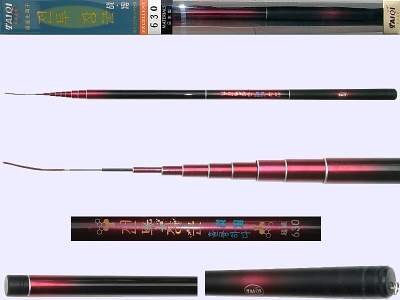
Carbon Fiber Telescoping Poles
There are a couple of caveats with these poles. There is no tip guide and the ends are a little flimsy. However if you wrap the top three sections with rod guide thread and coat it to strengthen the tip, it should suffice. You will also need to add very small rod guides, I used 3 mm guides, or buttons, yes buttons, to route the antenna wire down the pole. The buttons, two hole buttons, will need to be of varying sizes so that each will go further down the pole. The second hole of the button is what you thread the antenna wire through. If you use rod guides they should be mounted at the top of the last 3 or 4 sections so that the pole will still collapse. Once you start pondering this, while looking at a pole, it will make more sense. More on this in a later post.
I've found the best way to deploy an EFHW, where there are trees is to use the pole to place the end of the antenna, wrapped around a winder, over the highest branch you can reach with the pole. Let the winder fall to the ground and tie it off. So now the end of your antenna is 20+ feet high over the branch that you selected. Then thread the other end of the antenna wire down your pole and extend the antenna until the end of the antenna is a couple of feet off the ground, threaded down the pole. Use a velcro wrap to secure it, attach your matching device and you're good to go. I often prop my pole on the limbs of another tree, so there is no need to guy the pole.
So to sum up, this lightens the load considerably and the deployment approach eliminates the need to throw a line or use a sling shot to try to get it over the right branch.
I will post some pictures of my pole in a later post. The poles are available at http://www.allfishingbuy.com/
in a variety of lengths and wall thicknesses.
Wednesday, February 20, 2013
Alexloop in Action
The link below is to a video of Steve, WG0AT on a SOTA Expedition using the Alexloop.
http://www.youtube.com/watch?v=4x3TxPo1pMo&feature=player_detailpage
http://www.youtube.com/watch?v=4x3TxPo1pMo&feature=player_detailpage
Monday, February 18, 2013
The Alexloop antenna
As I have continued my research and experiementation on portable QRP operation I came across the loop antenna. In trying to understand the loop antenna I did some research on just how the antennas work and I came across the following explanation:
The fields from a small circular loop are given by:


.JPG)
The fields from a small circular loop are given by:
Now that I understand how they work, I thought I would look into available loop antennas .Loop antennas are nothing new and have been used for decades, primarily for receiving as they are very narrow from a transmitting perspective.
Historical references in portable magnetic loop antennas
Balkan’s War in 1942 Alder-shot England, November 1937
I started looking into commercial loop antennas and came across the Alexloop. The Alexloop is named after its designer, Alex, PY1AHD.
While researched the Alexloop, I watched some video of a Summit on the Air expedition using the antenna and heard him working into Europe with it, QRP. So I looked into the antenna.The antenna comes in a convenient carrying case, ideal for portable operation and includes a tuning mechanism that allows you to tune to maximum noise, indicating the best match between the antenna and the transceiver. It is designed to be handheld, but you can mount it on tripod if you want.
AlexLoop Walkham Small Magnetic Loop

I ordered the antenna and it recently came in the mail. So I put it together, which is fairly simple, hooked it up to my FT-817, running 2 watts, with a Te Ne Ke and sat out on my back patio to see if I could make a QSO. I answered the first CQ I heard, a station near Detroit (I'm near San Antonio, TX), and he came right back to me. The received signal was huge an he gave me a 559, but clearly had solid copy on me as we had an extended QSO, not just a signal report. He did ask about my power again because I don't think he could believe it the first time.
My conclusion based on the experience of others and my experimentation is that the Alexloop is a viable portable antenna that will yield good results.
.JPG)
QSO with Alexloop
Subscribe to:
Posts (Atom)