Pages

Labels

Showing posts with label QRP. Show all posts

Tuesday, April 24, 2018

The Pedernal - My SOTA Activation

Some things in life are very special and others, very ordinary. The difference, I suppose, is dependent on the individual. I recently had an experience that, to me, was very special and, of course, it is the subject of this post. As I write this April of 2018, I have summited more than 265 mountains, hills and mesas as I enjoy the Summits on the Air (SOTA) program. For the uninitiated, SOTA is an award program for amateur radio operators who get points for making radio contacts from qualifying summits. Some summits are tougher than others, some higher than others but a few are very special. One such special summit for me is the narrow mesa in northern New Mexico called Cerro Pedernal. In English, the words mean "hill of flint".

The Pedernal, as it is commonly known, was made famous by the American artist Georgia O'Keefe,  O'Keefe is quoted as saying, "It's my private mountain. It belongs to me. God told me if I painted it enough, I could have it." O'Keefe not only painted the mountain itself but incorporated its image in many other paintings. Moving to New Mexico permanently in 1949, O'Keefe painted the surrounding area in a prolific way, capturing the area in art as no-one has before or since. Upon her death, at the age of 98, O'Keefe's ashes were spread on the summit of the Pedernal.

Pedernal
Painted by Georgia O'Keefe 1942

 In SOTA speak, the reference for Pedernal is W5N/SE-018. A nondescript reference to a magnificent natural monument that doesn't do justice to the mountain it refers to. The Pedernal is much more than a number or a name. I had pondered climbing the Pedernal for a couple of years. One of my SOTA climbing buddies, Fred, KT5X, a full time resident of New Mexico, had climbed it a couple of times and had volunteered to show me the way. However, it seemed to never become a priority as we opted for easier climbs. Then an award was created by New Mexico SOTA aficionados called the Iconic Peaks of New Mexico award (check out WS0TA on QRZ.com for the list and rules). The requirement for a non-resident is to climb 5 of the 10 Iconic Peaks. I had done 4, The Pedernal would be the 5th and qualify me for Award #1 for the non-resident Iconic Peaks award. Not that I'm competitive but, with an award at stake, climbing the Pedernal became a priority.  

 Ascending the Pedernal is no cake walk. The summit tops out at 9,866 feet above sea level and dominates the horizon. Protected by cliffs, the summit is very narrow ranging from 10 ft - 20 ft wide and the slopes leading to the final, rocky ascent, are very steep. There is, however, a weakness on the back side of the mesa that allows those, willing to do a little rock climbing, access to the summit. Negotiating the rock face is the key to a successful climb.

The Near Vertical Climb
The actual route is up the left side

As we stood in front of the rock face standing between us and the summit, there was a bit of trepidation. I'd climbed faces more difficult than this in the past, albeit more than 30 years ago. After a few minutes of analyzing the route and some coaching on the best hand holds from Fred, I ascended the face successfully. The difficult part was over, but a steep climb up a narrow trail remained and close attention must be paid to ensure a totally safe ascent.

After some arduous climbing into the thinning air, we were on top. Summiting the Pedernal was an awe inspiring, almost spiritual experience. I've climbed dozens of mountains that are taller, much taller, but none of those climbs could match the experience of climbing this peak. I've stared at this iconic landmark for years, imagining what it must be like to be on top and now, here I was. For the first time in my SOTA activation history, I put the pack down and instead of grabbing the radio to set up, I picked up the camera to capture the moment. Fred and I spent 10 - 15 minutes just soaking it in. 

AD5A and KT5X on the summit of the Pedernal
We did finally put the cameras down and pick up our radios to set up on the summit. Too bad those calling us couldn't see what we saw as we made the QSO's, 31 of them with AD5A and 40 for WS0TA ( aka, KT5X),  which is a good day on any summit, but especially gratifying from the top of this iconic narrow mesa.
AD5A on top of the Pedernal
View from  the top
The trip down was uneventful, although I was a bit concerned about descending the rock face, getting down it was relatively easy. The hike back to the truck was very satisfying and I caught myself numerous times turning around to catch a glimpse of the summit from which I had just descended. Awesome.

Thursday, March 1, 2018

Keep The Faith, Having Fun With No Sunspots

I was motivated to write this today after looking at the solar flux number which sat at 67.  I don't know if I've ever seen the flux this low. I think I've seen 68 a lot, but not 67. Truly, things must be really bad.

As it would happen today, with the flux at 67,  I did my 258th SOTA activation on a summit near Santa Fe, NM that has no name, but goes by it's elevation, 8409. There are beautiful views in every direction, from the summit of 8409, and I enjoyed them immensely. With me, on my trek up the mountain, was my KX2, a 21ft. collapsible pole to support a 29 ft. piece of wire through an 81 to 1 transformer. I feed the antenna about a foot above the ground and run the wire up the pole in an inverted L configuration. The pole was propped up among the branches of a pine tree and I tied off the antenna to a close-by pine branch. I had the power set to 5 watts and tuned the wire with the KX2. I  operated CW using the Elecraft plug-in paddle and I logged with a golf pencil on a, Rite in the Rain, index card. The temperature was a crisp 39 degrees, but the sun was shining and not wisp of a breeze. It was a good day to be on the mountain top.

I was on the air from 1642z - 1722z. I operated on 40, 30m, 20m and 17m and completed 40 QSO's in the 40 minutes that I was on the air from 8409. Also, with the flux at 67, I managed to work two EU stations, ON and EA. I heard a 9A calling me but we couldn't complete the contact. So, 40 QSO's, coast to coast in the US and 2 DX QSO's from EU was my catch for the day. Not bad for a short QRP/portable outing. Keep in mind that's with the flux at 67. I'm glad I didn't look at the numbers before I left or I might have been a bit discouraged and perhaps wouldn't have gone out at all. I would have missed the beautiful views, the warming sunshine and a QSO a minute QRP operation. I wouldn't have worked EU with 5 watts and a wire. I would have had to put off my 258th SOTA activation for another day.

The moral of this story is simple, don't look at the numbers. In fact I would recommend that you ignore them. There is plenty of fun to be had keying up your radio even when conditions, or at least the numbers, are this bad.

Keep the Faith. Go call CQ. I was glad I did.

Tuesday, March 8, 2016

Chinese Kit Invasion

I suppose that I might be a little late to the game, so to speak, but I was browsing through the variety of  QRP kits on Ebay the other day and was shocked at what I saw. Many may already be familiar with  this phenomena in the QRP kit world, however it was news to me. A new Pixie 2 kit for $3.54 plus a whopping $1.80 for shipping. Now that's a QRP price. The kits were from China. As I considered this, I rationalized that at that price, something was askew, surely the quality was suspect, the parts incomplete and the instructions resembled some graffiti on an inner city wall. I passed it off as maybe a joke and went about my EBay browsing.

A few days later I stumbled upon an entry on the SOTA reflector entitled "QRPp Activation with a $3.56 Chinese Pixie..." by Manuel HB9DQM. Manuel had seen the radio on EBAy and couldn't pass up the opportunity to give it a shot. He not only built the radio, which takes the better part of an hour, but he decided to put it to the test in the field.

HB9DQM Pixie Station

Using the configuration above, running 300 milliwatts, he made 16 QSO's from a summit top bench. Pretty cool. 300 mw, wire antenna, battery power and a straight key, ah the magic of Ham Radio.

Of course the radio has limitations, it's crystal controlled, the radio comes with a 7.023 crystal (HB9DQM used a 7.030 crystal) and the bandwidth on receive is very wide, but as Manuel demonstrated, you can have some good, cheap fun with this little radio. He said he was listening to the world news, in English (courtesy of a BC station), while he worked the callers. An interesting diversion.

I did some further research on YouTube and found many happy campers who had purchased and assembled the kit. So I took the big plunge. I even went overboard and bought a couple of extra's as projects for my teenage grandsons who are hams.

There is one thing a little troublesome about this kit invasion however, at these prices, the other QRP kit providers can't compete. What will happen to them? Such is the world these days.

Chinese version of the Pixie 2
The inexpensive kits aren't limited to Pixie's, there are also '49ers, RockMites, etc.. Some even come assembled. I saw and assembled Rockmite, with a case for $35.00.

Saturday, January 23, 2016

VP8STI with QRP


Another small celebration in the shack. I wasn't sure the time was right to spend much time chasing South Sandwich with a QRP signal. I usually save that  attempt for the last day or two of a big expedition and the VP8 guys are still working to satisfy a lot of demand. In fact I did try earlier in the day and just rationalized, after calling for a while, that the pile-up was still too big. The other deterrent to my thinking was that they just weren't that loud. As a rule of thumb I figure the DX needs to be 559 or better for them to hear my QRP signal. However as the sun went down I checked the 20 meter pile up on the Elecraft P3, hmm, not too big on the screen. Their signal was probably only an S3, what the heck, let me have a go, as my British buddies would say. I turned the K3 down to 5 watts, hit the split button and started listening on the second VFO. I found him and followed him up for 4 or 5 QSO's and then he came back to me, just like he does with the big guns, AD5A 599:-) That was when the small celebration broke out.

I love this radio stuff.


Thursday, January 21, 2016

K5P on QRP

I managed a QSO with K5P yesterday on 20m CW with 5 watts out for my 180th country on QRP. I don't know why, but I am always amazed by this, especially when breaking a pile-up. I have a decent antenna, a log periodic up 50 feet, but so do most of the QRO guys. Always fun. I suppose that's what's interesting about ham radio, it's never the same two days in a row.

I will be looking to work VP8STI on QRP. I need some band slots on QRO, but still need them in my QRP log for the first time.The pile-ups will need to die down a little before I jump in.


I like this logo, nothing against the SSB guys, but it only has a morse key on it:-)

Sunday, January 17, 2016

SOTA Rig Reconfiguration

Activating SOTA's, if you do it regularly, is an iterative process. Of course the primary focus is to get to the top of whatever summit you might be tackling on a given day, but another part of the game is how you get there. Of course the right clothing to be comfortable in whatever conditions you face, the right pack to carry your gear and of course the right radio. But then, some of the fun begins. Not only the right radio, but how will I configure the radio to maximize my signal, be as light as possible and how to I package of this so I don't have radio gear all over the ground or digging in my pack to find the battery, paddle, etc.. I have activated 150+ summits and this is a continuous process.

Since I've retired, I've now have the opportunity to have continuous thoughts about things like this without the interference of work or schedule related thoughts, it's great. Consequently, I've had some time to give my rig configuration some thought. What I have done is not totally unique as I have gotten ideas from others and mixed them into my own concoction. I have the 3 Band MTR, with 17m, 20m and 30m. I chose these particular bands so that I would have flexibility on contest weekends. So below is my latest, not my last configuration.


As you can see I am using a backpacking cutting board as the foundation of the setup. I used a product called Scotch Extreme fastener to attache the LIPO battery and the Pico Paddle, it's sort of like Velcro but it snaps into place and is 10x stronger than velcro. I simply drilled holes (this board has seen several iterations as you can see the many holes), and used rubber bands to hold the radio in place. I may decide to use the fastener instead. The "Rite in the Rain" card is for logging. A nice neat package to pull out of the pack, hook up the antenna, plug in the power and off I go.

There are however a couple of further improvements.


You can see I've added a tethered pencil for logging and an optional Elecraft T1 tuner, if you have a non-resonant wire. I can fasten it to the board with either rubber bands or the Scotch fastener.

I've also added a protective cover for the MTR. It's made from sleeping pad foam and protects the face and switches on the MTR when getting jostled in your pack. On the backside of the cover I've cut out recesses where the switches are and added little magnets that are attracted to the four screws on the case. Thanks to Fred, KT5X for this idea.


So there you have it, a light, three band, package that is compact, light and ready to go. So until I reconfigure again.

Saturday, July 4, 2015

Field Day 2015

ARRL Field Day in an annual operating event designed to demonstrate and practice portable station operation. The Field Day exercise is important in that it shows how radio amateurs can be mobilized in the case of an emergency of any sort. Those involved in the planning of a Field Day understand the detailed planning required to construct, operate and tear-down a quality operating station. There is also the social side of Field Day that is the annual highlight for many clubs, that is a side benefit of the operating activity.

I haven't participated in Field Day for a couple of decades. This year I was invited to participate in the Field Day operation of W5YA. W5YA has won their entered category numerous times and has finished in the top 10 of all Field Day stations multiple times, operating QRP. Their success is directly correlated to meticulous planning and the excellent execution of that plan by the team of KT5X, K1JD, K5KM, NM5S, K7SO, K6XT, W0CCA and WD9FJL. The primary antennas are wire antennas strung in the trees at the Field Day site near Chama, NM.

My role this year was to fill in some shifts at the CW stations but primarily to supervise the operation of the GOTA (Get On The Air) station along with my son, Michael Jr., AB5EB. The GOTA station used my call, AD5A, as the GOTA station must operate under a different callsign than the primary Field Day station. The GOTA operators were my grandsons Reid, KF5GYE, age 14 and Boogie, KF5GYD, age 13. Both have their General tickets, but are not very active, which is a requirement of the GOTA station. My son and I would coach them during the event. Neither of my grandsons do CW, so we would be operating SSB, QRP. Not the easiest of assignments. Operating on a crowded band with beginner level operators is quite a learning experience for all involved. What was slightly frustrating in the first 12 hours was a delight in the last 12. Both boys learned a lot about operating QRP, proper procedures and amateur radio etiquette. In the final hours of the event, no coaching was needed. They  learned to handle both calling CQ and answering stations in a pile-up. Overall a fantastic result, the boys finished with 158 SSB QSO's from the GOTA station using 5 watts from a KX3 and a wire in the trees.

The final tally hasn't been made yet, but the CW station contributed over 1,400 QSO.s with wire antenna's and 5 watts of power. A very cool accomplishment and a testament to what is possible with amateur radio. Teaching us those lessons and getting new hams involved is what Field Day is all about.

We camped in a tent for two nights so I got to enjoy my son and grandsons in a great outdoor radio experience. Below is a video of the two GOTA operators. KF5GYD is operating and KF5GYE is cooking. The video should give you a flavor of Field Day.


Monday, December 29, 2014

Holiday SOTA Activations

So here we are, another year has past, and it seems, at warp speed. I hope each of you are enjoying the holiday season, however you celebrate it. Our family celebrates Christmas and I was able to spoil my grandchildren, so it has been fun indeed. Happy New Year as we approach 2015, and may you have health and happiness.

I am spending a few days at my Santa Fe, NM QTH for the holidays. There is snow on the ground and its only been above freezing about 3 hours since last Friday. However its a dry cold so its not too bad.

As always when I'm here I try to squeeze in some Summits on the Air (SOTA) activations. So far I've been able to do a couple as detailed below.

The Wagon Mound W5N/EL-016  6,930ft ASL  6 pts

The Wagon Mound gets its name from it's appearance. Without too much imagination you can see the outline of an old Conestoga Wagon on the summit outline. I chose this summit primarily because I've never done it, but also because, for the peaks in the area, it is at a relatively low elevation and the snow cover should be much less than higher peaks. When I departed Santa Fe, it was clear, sunny and 19F. I envisioned very thin snow cover, if any, on the mountain.

I was in for a little surprise, as you will see from the video below.


Wagon Mound, NM is 104 miles northeast of my QTH near Lamy, NM. About half way there we encountered fog. Visibility dropped, at times, to about 50 yards and the temperature dropped to 7F. I was beginning to have my doubts about making the climb. It was obvious that the snow accumulations were significantly more here, than back home. However I continued, postponing my decision until I could see the actual conditions at the base of the mountain..

Upon arrival, conditions had improved a little, visibility to 1 mile and the temperature was 13F at the base of the mountain. It wasn't a long climb, but it was steep. There was about 12 inches of snow on the ground. The problem with that is that this climb was a bushwhack over volcanic rocks and cactus. The snow cover completely disguised what might or might not be underneath. I decided to make the attempt. Cris, my XYL, was with me and she was willing to try as well. After all, we had just come over 100 miles.

The footing was treacherous. I had to plant my foot through the snow to discover what footing was below, whether solid ground or slippery rocks.We took our time and turned what should have been a 20 minute climb into about 40 minutes.

We set up about 30 feet below the summit, well into the activation zone. I used my KX3, 31 ft. piece of wire elevated with a 21 foot mast through a 9 to 1 balun, tuned by the KX3's tuner. Despite weather conditions, propagation was very good. I worked 31 stations on 20m CW in 18 minutes, a quick QSY to 40m yielded no results and since it was cold I didn't try any other bands. We packed up and retraced our steps down.

All in all a very satisfying activation given the challenges. We stopped on our way home in Las Vegas, NM and warmed ourselves up with some Mexican Food. A good day.

Summit 6860 W5N/SI-022  6,860ft ASL  6 pts

After my experience heading north, I decided to go south for my next activation. This summit is east of Albuquerque NM just south of I-40 and 67 miles from my QTH. This is a nice summit. Depending on where you start, the hike is 2. to 3 miles round trip. The elevation change is about 800 feet over that distance. There are numerous crisscrossing trails over the terrain, so there are multiple ways to get to summit. The trails are all nice trails, no bushwhacking required on this one.

The weather was near perfect for climbing, about 40 degrees, sunshine and little wind. Very enjoyable. You will see from the video below that the conditions were splendid and there was a little snow on the ground.


I used the same set-up here as described above. Conditions were good, 31 QSO's on 15, 20, and 30 meters.

So 12 more points in the log and some good exercise and, obviously, some stories to tell.

Happy New Year!!


Thursday, August 7, 2014

Rocky Mountain Rendezvous

I was fortunate to attend the SOTA Rocky Mountain Rendezvous that occurred from July 31 - Aug. 3 in Buena Vista, CO. This year's Rendezvous was a no-host affair with informal gathering of SOTA Activators. Participants consisted of  locals, visitors in rented cabins, campers, etc.... It was a great time. The group that I was a part of rented a house about 12 miles outside of Buena Vista and little did we know there were two SOTA peaks within a 5 minute drive to the base of the mountains. Staying in the rented vacation home were Fred KT5X (aka WS0TA), Guy N7UN (ask NS0TA), John K1JD, Doc K7SO, Alan NM5S, Curtis KC5CW, my grandsons Reid KF5GYE and Boogie KF5GYD (both General Class), my XYL Cris KC5HZQ and myself.. Camping, about 5 minutes away at the base of Kaufman Ridge, was Steve, WG0AT along with Acorn and Barley.

We had a Dutch cookout on Friday night which attracted all the finest people including, Bryan N0BCB w/XYL and friends,Walt W0CP w/XYL,  Dave NN5K w/XYL. Seems like some others, but these are who I can remember. We had a great time grilling burgers, steaks, brats, etc... and swapping SOTA stories.

The RMR coincided with the 14er event put together by Bob K0NR, who stopped by the SOTA house on Saturday night along with his XYL Joyce, K0JJW. The event is an annual event (ham14er.org) which encourages hams to actuvate one of the 14,000 ft. summits in Colorado. As a SOTA chaser and activator, it is a cool event with lots of activity on both HF and VHF.

While in Colorado I was able to active 3 Summits, Kaufman Ridge (10,700 ft. ASL) W0C/SP-081, Horseshoe Mountain (13,900 ft. ASL) W0C/SR-064 and Mt. Sherman (14,034 ft. ASL) W0C/SR-061.

My grandsons and I were fortunate to be able to climb Kaufman Ridge with Steve, WG0AT and he two SOTA Goats, Barley and Acorn. We had a great hike and my grandsons loved interfacing with the goats. Steve did a video of our climb and it can be found at the link below.

https://www.youtube.com/watch?v=EcWGh7Wl3Gw


                                                               KF5GYE (Reid), Barley and Acorn on Kaufman Ridge


                                                          K1JD and AD5A on Mt.Sherman, 14,034 ft.


                                                             KF5GYD (Boogie) on Horseshoe Mt. (13,900 ft. ASL)


                                                      Panorama from Horseshoe Mt. (13,900)

It was a great trip and something all SOTA activators should consider doing.

Wednesday, June 4, 2014

KX3: Cool Go Box

I just came across this on the internet the other day, but I thought it was a very cool way to package the KX3 for portable operation.


Check out www.oe2atn.at/tom/gobox

If  someone would commercialize this, I think it would be very popular.

Friday, May 30, 2014

Why Do I Like Operating QRP From Summits?

I have given this question a lot of thought. I've been licensed since 1989, that's 25  years of very active operating. I'm #1 on the Honor Roll, over 1,030 IOTA's confirmed, 5BWAZ, 9 Band DXCC, etc... So, as you can tell, I love the hobby. Given all my ham radio acheivements and activities I can't recall being so enthused about any part of the hobby as I am about the Summits on the Air program. So why is that? I came up with a few thoughts.

I enjoy QRP because it fits my minimalist philosophy of life. What is it that I really need to exist? Operating QRP is like catching a 10 lb. bass on 3 lb test line, it's like sleeping under a lean-to rather than a tent, using an EFHW instead of a beam, it's like David versus Goliath. In short, its a challenge to begin with and thrill when you succeed.

I like managing the gear. I'm always looking for better ways to manage a summit activation from logging to power supplies to antennas to radios. I 'm always looking for the lightest, most efficient approach.  I like that no two activations are exactly alike. Deciding where to set-up, which tree has the best antenna support characteristics, where is best protection from the elements. The shack at home changes very little over time. It's almost boring.

I like the planning, topographic maps, coordinates, routes. I like the exercise, the incentive to stay fit so that I can enjoy what nature has to offer regardless of the altitude. I love the views. It makes me feel alive.

I like the points, the sense of achievement, although it's not always the achievement, it's the chase. The pursuit of the goal is what is motivating. I enjoy the chase.

I enjoy the comradarie of like minded indivduals and the SOTA program is very strong in that regard, it's full of people who love the outdoors, who enjoy QRP and like the challenges of both.

I just had to write it down.

Saturday, May 3, 2014

Texas SOTA Trip - The Law of Averages

The "Law of Averages" is a layman's term used to express a belief that outcomes of a random event will "even out" over time. While statistical experts may argue the validity of this thinking in the short term, what do they know anyway. So, you may ask, what does the law of averages have to do with SOTA?

As I have written here recently, the SOTA program recently added 40+ one point summits in South Texas. These summits are within a reasonable drive for me, so I was enthusiastic to activate them and after all, they are all one pointers, they should be easy enough. Just as a reminder for those who haven't caught the SOTA virus yet, point values range from 1 - 10. Oddly enough, 1 is the only odd number used in the valuation scale. Summits can be worth 1,2,4,6,8 or 10 points. Don't ask, I have no idea.


 I've already activated Peak 2002, which was the first South Texas group summit activation. I ended up walking 8 miles for that point. Not to worry though, they can't all be that long. So in the spirit of adventure (and not point accumulation), I planned to activate two of these summits during the International SOTA day and the QRP to the field (QRPTTF) events. My two targets were Bullhead Mountain, W5T/ST-007, and Pikes Peak, W5T/ST-029. Yes there is a Pikes Peak in Texas. The one in Colorado is worth 10 points, the Texas version is worth, the aforementioned, one point.


 I'd done my research and determined that there was a better than even chance these summits would be accessible. While on private land, these peaks are in sparsely populated areas that likely aren't posted. However you never know until you get there.


Bullhead Mountain, W5T/ST-007, is a limestone peak north of Vance (formerly Bullhead) and the intersection of Farm roads 335 and 2631 in far western Real County (at 29°49' N, 100°00' W). The summit, at an elevation of 2,042 feet above sea level, rises on the southern edge of the Edwards Plateau. Local vegetation includes open stands of live oak, Ashe juniper, and mesquite on the uplands and ridges and live oak and Ashe juniper woods on the hills and escarpments. 


The Trail up Bullhead, One of more open areas
Operating from Bullhead Mountain
The best approach to this summit is from the Farm Road 335 side or the south side of the mountain. The fence is deteriorated and it is not posted. The approach on the Hwy 2631 side is posted. This one pointer is no bargain. You will climb 400 feet in about 1/4 mile. Translated, that is steep and the extra bonus is that there are no trails. The slopes are covered with all manner of hard to get through trees and underbrush combined with loose rock to make for an adventurous descent. This is Bushwhacking with a capital B. We did finally summit and had some nice views.
View from Bullhead Mountain

The bands were a little finicky. Only made QSO's on 20 meters. Nothing on 12m despite the RBN hearing me at PJ2T.
Cris and I. Our Jeep is the black speck on the road


View from Pikes Peak
So after the descent of Bullhead Mountain, we made the short drive to Pikes Peak to discover what awaited us there. Pikes Peak, W5T/ST-029  is a mile north of Camp Wood in extreme southeast Edwards County (at 29°41' N, 100°02' W). It rises to a height of 1,904 feet, 470 feet above the nearby Nueces River. The summit was named for Zebulon Pike, whose exploring party passed near it on its return from the exploration of Colorado in 1807. The area's steep to gentle slopes are surfaced by variable soil that supports scrub brush and sparse grasses.

This summit was every bit as tough a Bullhead. There is a road that goes over the shoulder of the mountain which means you only have to climb 300 feet in about 1/3 of a mile. Again, that's steep and again no trails. I operated from the very top of the summit. A nice breeze cooled us down for the now 85F temperatures.


Operating from the Summit of Pikes Peak, Texas
Propagation had warmed up a little by the time we summited, but not much. I doubled my QSO count on this summit, but still most of the business came from 20m. I was able to work five summit to summit contacts which is always rewarding. Portable QRP to portable QRP, from mountain to mountain. Pretty cool. The high bands, 12m and 10m were not really productive, only one QSO on 12m and none on 10m.
We had contemplated doing Wildcat Peak also. Another one pointer, not too far from Pikes Peak, however, we were tired. These ascents and descents were taxing because of the steepness and the full time bushwhacking through brush and the temperatures were warming up. My thermometer in my jeep read 90F when we got down.  We had a nice Texas lunch in Camp Wood. A lunch buffet with Mexican food and Chicken Fried Steak. It doesn't get much better than that.:-)
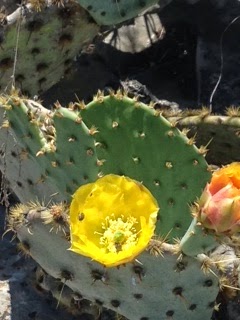
Cactus Flowers
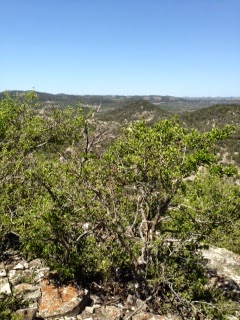
Texas Mountain Fauna


So, what about this Law of Averages? Well, in the SOTA world there are some easy summits. Some you can even drive up  to the summit or park near the top and take a nice trail a few yards to the summit. I have felt a little guilty about that in the past, getting so many points for so little effort, but no more. The Law of Averages does apply to SOTA. These one pointers were intense, difficult mountains to do. However, I suppose it all averages out. After doing these mountains, my guilt in doing an easy one has disappeared:-)

Photo credits to my XYL Cris, KC5HZQ
Excerpts above were taken from the Texas State Historical Association.

Friday, April 4, 2014

The First Activation of a South Texas SOTA Summit - Peak 2002

The SOTA Management Team recently authorized a group of qualifying summits in South Texas. These summits are located generally west of San Antonio in the Texas Hill Country. The elevation of these summits range from ~1700 - 2200 feet ASL. All of these new summits are only 1 point summits, however, they are new and have never been activated which begs for someone to do them for the first time. So today, I was the first to activate a South Texas Summit.

I have only done limited research and actually stopped looking when I found the first accessible summit. The summit, named "2002" for it's elevation because it is otherwise unnamed. The summit is an escarpment, which is defined as, "a long precipitous, cliff-like ridge of land, rock, or the like, commonly formed by faulting or fracturing of the earths crust".  Peak 2002 is just that with a summit ridge that runs for nearly a mile. Accordingly it has a large activation zone. (In SOTA, the operator doesn't necessarily need to transmit from the actual summit, in Texas the activation zone is anywhere within 150 vertical feet of the summit). The majority of the summit ridge is on private land, however the eastern third of the summit lies within the boundries of the Texas Hill Country State Natural Area. So an easy, state park hike, should be easy.

View from the Trail

Looking at the layout of the park, the ranger told me which trail would get me to the summit ridge, trail 4B. I downloaded the map and the trail was in the middle of the park, but I would be able to drive to the trail head right, wrong. The Ranger informed me that because this is a Natural Area I would have to walk. What I thought was, at most, a 2 mile round-trip was now a 6 mile round-trip. Wait a minute this is just a 1 point summit. But I was there, but I knew I didn't have enough water for 6 miles, so I bought a bottle of water at the Park Office, got directions and took off.
South Texas Fauna

So what was a 2 mile round-trip which had now become a 6 mile round-trip, turned out to be nearly 8 miles. I missed a trail due to a poorly marked trail sign and was almost a mile down that trail when I realized my error. So I had to back track and get on the right trail. Finally 1 hour and 40 minutes after leaving the trail-head I reached the summit ridge.

From that point, it was a fairly normal activation. I used my MTR and a 20/40m EFHW and my Pico Paddle. I managed 22 QSO's with the first being AE4FZ and the last being KD5KC, Mike who did the bulk of the work to get the additional Texas Summits approved. Thanks Mike. I was also able to work a little DX with OK1CZ calling in on 20m.
A Selfie from the Trail

So this was another SOTA first and I'm glad I was able to be the first to activate a South Texas Summit. I will have to say though, this was the toughest SOTA point I ever earned. Eight miles of hiking for 1 point, the miles per point is pretty high. If you extrapolated that ratio to a 10 point summit a person would have to walk 80 miles. Well as they say, everything is bigger in Texas.

Thanks to all the chasers and thanks again to Mike KD5KC who was a catalyst in getting these summits approved.

Sunday, February 9, 2014

Upgrading My FT-817

The FT-817 is a great little radio. It has been around for 15 years and was the first QRP radio, that I'm aware of, that was designed for backpacking and covered 160m through 70cm. It is housed in a rugged package that is efficient, and is relatively easy to pack. The radio sells for ~ $660 and is a great value for the money. It has been the undisputed leader of it's class until the entry of the Elecraft KX3 came to market. The KX3 is a fine radio that clearly has more bells and whistles than the FT-817 although it is doesn't cover 2m and 70cm in its base model.

I have both radios but favor the FT-817 for SOTA expeditions when I choose to carry an all band radio. (I usually carry CW only radio that is much lighter, but carry the FT-817 on some trips). Clearly the out of the box filtering is better on the KX3, but so is the price. You can buy two 817's for the price of a KX3. However that said, I set out to modify my 817 to see if I could close the gap between the two. So I added the W4RT On Board Filter ($284) with both SSB and CW (300Hz) filters. I also added the BHI DSP filter ($169). These prices include installation by W4RT, if you do it yourself you can save a few bucks. These modifications, in my opinion help to close the gaps between the two radios considerably.

Below are some very basic, unscientific, comparisons of the two radios on SSB and CW.

CW Comparison


SSB Comparison


As you heard in the videos the differences boil down to a matter of taste. I think the 817, with the 300Hz filter comes very close if not better than the KX3 on CW, on SSB the KX3 has the advantage but the DSP does clean up the noise and the SSB filter does sharpen the 817 audio considerably. I favor 817 for outdoor work and the KX3 for the in-shack QRP radio.

In future blogs I will discuss a couple cool additions to the 817.

Thursday, February 6, 2014

FT5ZM with QRP

All major expeditions are chaotic in the first days. Panic sets in as days go by and contacts aren't made, logs aren't posted, propagation doesn't cooperate and on and on. It is a very predictable pattern. However there is also a predictable pattern in the last days of  a major expedition and that's comments on the reflector of, "finally made it", "on 14.023 begging", "working simplex", " worked with a wire", "worked first call", "worked mobile!!!" and finally, "worked QRP". An so that time has arrived for the FT5ZM expedition.

I can't say enough about the quality of this team and their operating plan. Amsterdam is antipodal to my QTH and yet these guys have been workable on most bands, I have worked them on six bands using my battleship sized station and yes, I worked them yesterday QRP with my FT-817 on 20m. Over 2,000 miles per watt! It's ironic, but there is power in QRP. There was a small pile-up, relatively speaking, covering 2-3 KC's but my 5 watt signal travelled almost exactly half way around to the world to be copied by a station almost 12,000 miles away. Very cool.

The QRP contact was the first good news of the day, the second was a bonus. The common grayline/shared darkness with FT5 and my QTH in W5 is about 30 minutes. Yesterday around 0028z, with still some faint sunlight, the FT5ZM signal came out of the mud on 3.523 listening up 2. I use only an inverted L on 80m at about 55 feet at its apex, so we aren't talking about a superior antenna. Their signal was in the 339 - 449 range. Very light copy, but solid. I was excited just to copy them. I am usually confident when I jump in a pile-up, but not this one, figuring the east coast would drown me out. However on about the fourth call I could hear faintly but solidly, AD5A 599, I went back, de AD5A 599 599 bk.......AD5A 599 599. Oh no, he didn't hear me come back.....de AD5A 599 599 599 bk.......AD5A 599 TU UP.....Yesssss! An unexpected bonus and a short victory dance and another short one when the QSO was verified in the online log today.

 There are so many ways to enjoy radio and yesterday was another fun day in this wonderful hobby of ours.

Sunday, January 26, 2014

QRP/SOTA Fun Without Climbing A Mountain

Rather than activating summits, I spent the weekend at my small ranch near Rocksprings, TX. I have a nice QRO station there with 107 foot Rohn 55 Tower, a Log Periodic, 40 Meter beam and wires on low bands. I can work a lot of stuff from there. However, I had a plan this weekend to test a few antenna configurations for my QRP operations from SOTA summits.

So I set up my operating position just as I would on a summit. I was testing one of the SOTA beams EFHW antenna with counterpoise and a homebrew 29 ft. wire. I brought along two tuners including Hi-Tee Tuner from SOTAbeams and a recently acquired Hendricks SLT+ 80m-10m end fed half wave tuner.

The SOTAbeams combo was my first configuration. I put the antenna over a limb about 15ft. up and let it slope down to another limb about 7 feet up and then down to the radio. The antenna wire terminated into a 4mm plug that prevented me from running through the eyelets of my pole. I plugged the wire into the tuner (which will only take a 4mm plug, there is no binding post) as well as the counter poise. The antenna tuned nicely and I had QSO with a station in Arizona. As I finished that QSO I tuned across the SOTA frequencies and heard W0CCA calling CQ SOTA from a summit in Arizona on 20m. Cool, now could I work him with this set-up? I usually don't have to wait long in a pile-up but for this QSO I would have to. I was tempted to run over to the QRO shack and make the contact to ensure I got the points since he was on a 10 pointer,  however I resisted the temptation. My faith in QRP was rewarded, Cap finally heard me and gave me a 229. Cool.

So now I set-up the simple 29 ft. wire. Since it didn't have the banana plug on it, the Hi-Tee Tuner was useless, so I set up on the SLT+. I was able to use my pole this time, so the wire was higher off the ground in an inverted L configuration. By that time KX0R was calling CQ SOTA on 20m from a summit in Colorado. Evidently the pile-up had run it's course because I got him on the first call. So my little tuned wires had netted 12 SOTA chaser points. I am regularly amazed by QRP, how much you can do with a few watts and some wire.

A great day of QRP/SOTA fun.

Tuesday, January 21, 2014

More Battery Power for the FT-817

I occasionally use the Yaesu FT-817nd on my SOTA expeditions if I want to use higher bands on the activation or for some odd reason want to operate SSB:-). I actually prefer it to the KX3 simply because it is less bulky and it performs well in the field. One of the concerns I have with taking the 817 is; should I take an external power supply since the internal, rechargable, battery can have a relatively short life span. This is due to the power required to operate the 817 versus smaller, CW only radios. I was looking for a higher capacity battery made for the 817 and came across an interesting offering on EBay. The link is http://www.ebay.com/itm/3000mAh-Polymer-Lithium-Battery-pack-back-door-holder-Yaesu-FT-817-ND-radio-/331093734430?pt=US_Radio_Comm_Antennas&hash=item4d16b9741e#ht_4797wt_706

  The product is a 3000mAh LiPo battery that fits the 817, a replacement for the battery door that allows the battery to be charged by an external charger (included) and a nice stand for the radio. (The battery that comes with the 817 is 1400mAh) All this for $89. Now, it is a product made in China, so it is tough to determine quality, (that's also true for certain US producers as well). I ordered the package and will test it to see if it is as advertised. W4RT offers a similar product but it's priced at $150.00 and the battery is a NiMH.

I have no commercial interest in this product, but it seems worth the money if it delivers as advertised.

Thursday, January 16, 2014

Pico Paddle

A few months back I ordered a Pico Paddle from Palm Radio. It is very small paddle, weighing only 12 grams by itself or 27 grams with the magnetic quick mount. The paddle is extremely well engineered and comes in a nice travel case with two quick mounts and cable. I have recently been using the paddle on my SOTA expeditions and have found it to be a very good paddle to have in the field. There are a few oddities about the paddle that are worth talking about, but overall it is a very well made, functional paddle.

Pico Paddle

Magnetic Quick Mount

 The cable used to interface with your rig is a little unique, in that it is a 2.5mm - 3.5mm and it is reversed with the tip being the dah. So it is a little different than the typical set up. If you are using the paddle with an FT-817 or a KX-3 or similar commercial transceiver, a simple adjustment in the menu will fix the reversed cable issue. If you are left handed, then it's perfect. The problem comes if you use the Pico paddle on a home-brew radio that doesn't have the ability to adjust the dits and dahs. You can do you own fix by cutting and reversing the wires and I suppose if you are using the paddle at a home station this would be sufficient, but the cable wires are thin and the solder job doesn't  hold up well with portable use. There is a pre-made reverse wired cable available from MTechnologies that is a much better alternative.

One nice feature of the paddle is the quick mount. It a very strong magnet that allows you to mount the key on the radio. In the field this is a nice feature and prevents you from having to hold a small paddle and log at the same time. I recently used it in combination with my MTR on a SOTA  trip and I really liked the way the radio and paddle were integrated.

Pico Paddle Mounted on MTR w/magnetic quick mount

Another nice feature of the Pico is that the paddles retract into the housing when not in use. I'm always in search of an efficient, light portable solution for SOTA Operations. These set-up works very well. 

I have no financial interest in this product, I'm just sharing my experience with it. If you Google it you will find the dealers who carry it.

Monday, January 13, 2014

Three Summits in the Wichita Mountains

This trip to the Wichita Mountains in SW Oklahoma was not a firm plan. Unlike many of my SOTA expeditions, I only carried my radio gear in case I was able to use. Unfortunately, I was in Ft. Worth, Texas to attend the funeral of my Aunt and as always, at funerals and weddings, there are always lots of family and friends to catch up with. I figured that the reunion might last through the weekend. However, after the funeral on Friday most of my relatives dispersed back to their busy lives.  I suggested to Cris, my XYL, that we sneak off to the Wichita Mountains for a SOTA date. She agreed, so we set out for Lawton, Oklahoma, which is a 2.5 hour drive from where we were. Upon arriving in Lawton around 10:00p.m., I opened up my iPad and put together a plan.

I had lived in Duncan, Oklahoma for eight years in the '80's and early '90's and had visited the Wichita Mountains multiple times with my family and our Boy Scout Troop, but never with summits in mind. So the must do summits in the Wichitas are Mt. Scott and Elk Mountain. Mt. Scott is a drive up and Elk Mountain is a nice 1.1 mile hike, one way. I knew if I started early, three summits were doable, maybe even four. But which one would be the third? I remembered KC5CW and KD5ZZK operating from a four point summit not far from Mt. Scott, so after a little research, Mount Cummins was added to the list. Below is a report on the trip.

For this trip I used an MTR 20/40, 500 mah Lipo battery, 21 foot collapsible carbon fiber pole and a LNR 10-20-40 "trail friendly" End Fed Half Wave antenna.

Mount Scott W5O/WI-002

This is an easy summit. The weather was on the chilly side with temps in the mid-30's when we started out. Upon arriving on the base of the mountain, there was a squad of army soldiers getting ready for a run up the mountain, something that would appeal to Fred, KT5X, but I was happy to drive up this one. At the summit, there was only one other car, so I had a pick of operating sites. I elected to get out of the wind and down a ways from the summit.
Operating Site on Mt. Scott

The views from Mt. Scott are fantastic, mainly because the mountain rises above the relative flat plain of grasslands. Lake Lawtonka is part of the backdrop. But it was a little chilly. The tree in the foreground of the picture is what I used to support the end of my antenna which I then brought to the operating position down my carbon fiber fishing pole.

Operating on Mt. Scott with MTR

Signals were good and I made 18 QSO's on 20 meters. When I QSY'ed to 40m I didn't get spotted by RBN so I self spotted. Nothing. I wrote it off to poor propagation. However, as I figured out on the next summit, changing bands on the MTR requires changing three switches, I had only switched two and wasn't putting out a signal, so my apologies to the 40m chasers.

View From Mt. Scott

While I was operating I heard some cadence based singing. I thought my wife was listening to something on her iPhone, but it was the army squad. Not looking as fresh as when we saw them at the bottom, but the worst was over. 

Elk Mountain W5O/WI-007

Elk Mountain 8 or 9 miles west of Mt. Scott and it is a great SOTA summit. It has an easy to follow trail that isn't too long (1.1 miles one way) and great views at the top. This would be a great summit to practice on to get prepared for higher elevation, longer climbs. My wife and I made the climb in 30 minutes.

The trail head is at the Sunset Picnic Area and begins where the bridge crosses the creek. By the time we got on the trail the temps had warmed to the upper 40's and the sky was clear, a beautiful day. The climb is straight forward and the summit is large so you have a lot of room to set up. However there no substantial trees on the summit, so this necessitated a different set-up for the antenna. I set up a little below the summit and used an inverted L configuration, running the wire up the pole and then letting it slope down from the top of the pole.

Operating on Elk Mountain

Propagation was good and signals were strong. I received several reports greater than 559 and several 599, so everything was working. I made 22 QSO's on 20m and 4 QSO's on 40m. Included in the log was S58AL.

Toward the end of the activation, a group of boy scouts gathered to watch. I gave them an impromptu lecture on ham radio in general and SOTA in particular. They were very attentive. I told them that the internet was hard wired, but ham radio was magic.

Cris captured my impromptu talk with the Scouts

View from Elk Mountain

Mount Cummins W5O/WI-031

Mount Cummins is also a relatively easy summit, however finding the way to the top was a little more of challenge than I expected. My GPS took me to the wrong side of the mountain. The cell phone tower is the landmark, so I kept driving until I found the road to the tower. The cell tower site is in the activation zone, however, I wanted to get up on the summit to get the antenna deployed, so I did  a little bushwhacking.

On my way up Mount Cummins

There is a lot of scrub oak on the mountain that makes getting to the top a little more challenging than you would think. In the picture above, the cell tower fence can be seen in the right. The antenna above me in the picture must be a repeater antenna. The summit is relatively large, I set up on the summit ridge.

Operating Position on Cummins

You can see the beautiful day, with clear skies, temps now in the lower 60's. I made a total of 27 QSO's with all but four on 20 meters.
Running the Pile with the MTR

This was a fantastic day of SOTA fun. I earned 22 Activator points, enjoyed a beautiful day outdoors and enjoyed a SOTA date with my wife Cris. She loves photography, so this trip gave her some material and a good excuse to use her camera.

This is the first time I've done three summits in a day. My equipment performed well and I received better than average signal reports. I don't know if it was simply propagation or the inverted L/sloper configuration was better. At any rate, it was fun.

I had planned on maybe doing a fourth summit or maybe getting up early Sunday to do one more before driving home to San Antonio. However we received news that our daughter-in-law, who is six months pregnant, was having an emergency appendectomy, so we made the 7.5 hour drive home instead. Both mom and baby are fine.

Thanks to all the chasers. This SOTA stuff is fun.

Tuesday, December 17, 2013

QRP and 10 meters

As we move past the peak of this current solar cycle it seems that we are enjoying some of the best conditions on the high bands in several years. However, there does seem to be a sense of urgency to enjoy 10 meter DX since these conditions will likely last a few weeks rather than a year or two as in past cycles. I remember when I received my Novice license in 1989 that 10 meters was so busy you could hardly find a spot to call CQ in the Novice band, 28.300 - 28.500.

Since the flux has been in the 160 -170 range lately, last week's 10 meter contest was full of activity. It was a great opportunity for me to increase my QRP DXCC count which was at 160 entities worked going into the weekend. The bottom line, with the exception of V55V on SSB, I was able to work everyone I chased. It was harder work that I thought it would be, which is a testament to how busy the band was.

So with the band hopping, I fired up the KX3 and went hunting. I was able to work TK5EP, 4O3A, OX3XR on CW and ZS1TMJ on SSB. It was Saturday morning when I made these QSO's, so it was still early in the contest, I'm sure on Sunday, these stations would have been a little easier to work. I picked up four new counters on 10m and threw in FG5FR on 15m to get my QRP DXCC to 165. It was a fun weekend and it's good to hear some much activity on 10m.

So, go have a look at 10 meters, better yet, call CQ. You mght be surprised who comes back.